The Best Self-Improvement Book - The One That Keeps Changing Lives (And Why It's Still Atomic Habits)
As we step into 2026, many of us feel that familiar pull toward growth.
The desire to become calmer, more focused, more resilient in a world that seems to accelerate every year. We search for guidance, for a book that does not just inspire in the moment but creates lasting change.
After reviewing bestseller lists, Goodreads ratings, reader testimonials, and cultural impact through 2025, one book stands above the rest as the most influential self-improvement read entering 2026: Atomic Habits by James Clear.
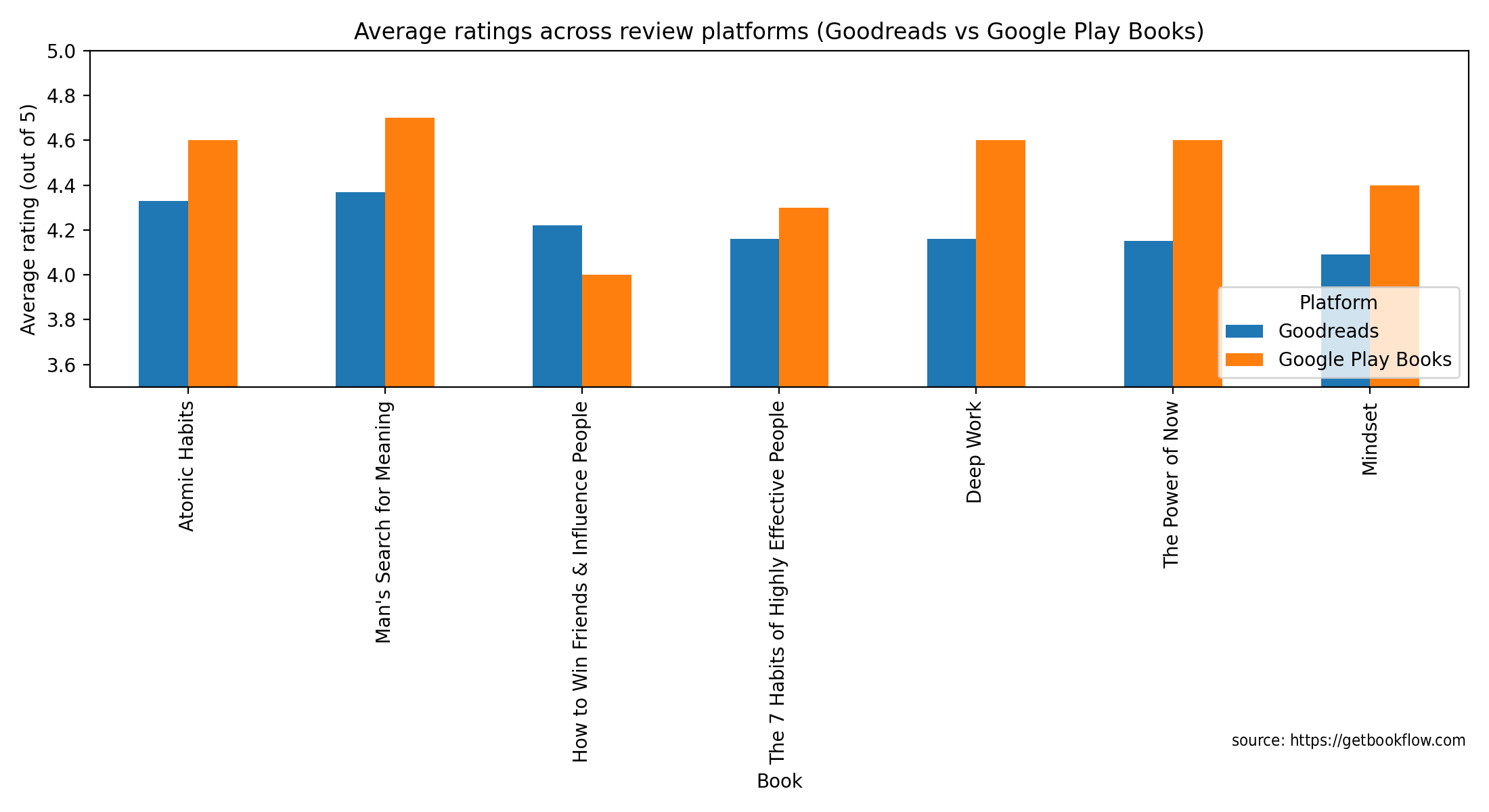
Here’s what the current ratings show from two major, widely used review platforms:
Goodreads (avg rating):
Man’s Search for Meaning 4.37 (852,525 ratings) Goodreads
Atomic Habits 4.33 (≈1,147,117 ratings) Goodreads
How to Win Friends… 4.22 (1,140,419 ratings) Goodreads
7 Habits 4.16 (809,737 ratings) Goodreads
Deep Work 4.16 (187,318 ratings) Goodreads
Power of Now 4.15 (446,351 ratings) Goodreads
Mindset 4.09 (174,691 ratings) Goodreads
Google Play Books (avg rating):
Man’s Search for Meaning 4.7 (436 reviews) Google Play
Atomic Habits 4.6 (1.63K reviews) Google Play
The Power of Now 4.6 (1.76K reviews) Google Play
Deep Work 4.6 (107 reviews) Google Play
Mindset 4.4 (260 reviews) Google Play
7 Habits 4.3 (18 reviews) Google Play
How to Win Friends… 4.0 (235 reviews) Google Play
Published in 2018, it has sold over 15 million copies worldwide, maintains a 4.35 average rating on Goodreads from more than 1.2 million reviews, and continues to dominate Amazon and bookstore charts. In 2025 alone, it outsold most new releases in the category. Why? Because it offers something rare in self-improvement literature: a clear, evidence-based system that works for real people leading real lives.
Let me explain why Atomic Habits earns the title of the best self-improvement book in 2026, how it has transformed millions (including my own approach to daily life), and why it remains essential even as new titles emerge.
The Core Idea: Small Changes, Remarkable Results
James Clear does not promise overnight transformation.
He rejects the myth of willpower alone and instead focuses on systems. The central thesis is simple yet profound: tiny habits, improved by just 1% each day, compound into extraordinary outcomes over time.
Clear breaks habit formation into four laws:
Make it obvious (cue)
Make it attractive (craving)
Make it easy (response)
Make it satisfying (reward)
He draws from neuroscience, psychology, and behavioral economics, but presents everything in plain language with relatable stories. There is no fluff, no pseudoscience, just practical tools you can apply immediately.
For example, he introduces "habit stacking": pairing a new habit with an existing one. Want to read more? Stack it with your morning coffee: "After I pour my coffee, I will read one page." Want to exercise? "After I take off my work shoes, I will immediately change into workout clothes."
These are not revolutionary ideas in isolation, but Clear synthesizes them into a framework that feels fresh and actionable.
Why It Stands Out in 2026
In a year when new self-improvement books focus on AI productivity hacks, emotional regulation in a polarized world, and recovering from burnout, Atomic Habits endures for several reasons.
First, it is timeless.
Unlike trend-driven books that date quickly, its principles apply whether you are building habits around analog journaling or digital detoxing. In 2025 surveys from Goodreads and Book Riot, readers consistently named it the book that created the most sustained change in their lives.
Second, it is evidence-based without being academic.
Clear references studies but never overwhelms. He shares failures from his own life—a serious baseball injury that forced him to rebuild through small habits—making the book deeply human.
Third, it addresses the root of most self-improvement failures: focusing on goals rather than systems.
As Clear writes, "You do not rise to the level of your goals. You fall to the level of your systems." In an era of endless distractions, this reminder feels more relevant than ever.
Finally, its impact is measurable.
Millions report quitting smoking, losing weight, building businesses, or simply feeling more in control, all by applying its methods. In 2025, it inspired countless viral challenges on social media, from "habit trackers" to "1% better" communities.
A Personal Reflection: How Atomic Habits Changed My Own Path
I first read Atomic Habits in late 2019, while trying to learn programming and get into tech as covid lockdowns started in my country.
I was overwhelmed, starting new routines while letting old ones slip. Like many, I had tried grand overhaull. New Year's resolutions that collapsed by February.
Clear's book shifted my perspective.
I began with one small change: after brushing my teeth at night, I would write three things I was grateful for. It took thirty seconds. Within weeks, it became automatic, and my sleep improved noticeably.
Emboldened, I stacked coding onto my morning routine. It wasn’t a matter of whether I did it right or not, I just needed to do it for 20 mins a day (sometimes longer when I get in flow state). Over time, these atomic adjustments compounded. By July 2020, I was already coding web apps by myself using the Popular programming language, Python. The changes were not dramatic day-to-day, but looking back just months later, my life felt fundamentally different and better.
This is the quiet power of the book.
It meets you where you are, without judgment, and provides tools that scale from minor tweaks to life-overhauling transformations.
Honorable Mentions: Strong Contenders in 2026
While Atomic Habits holds the crown, several other books deserve recognition for their influence and relevance entering 2026.
The Power of Now by Eckhart Tolle – For those seeking spiritual depth and presence amid anxiety.
How to Win Friends and Influence People by Dale Carnegie – Timeless wisdom on human relationships.
The 7 Habits of Highly Effective People by Stephen R. Covey – A holistic framework for personal and professional effectiveness.
Man's Search for Meaning by Viktor E. Frankl – Profound insights on finding purpose through suffering.
The Subtle Art of Not Giving a F*ck by Mark Manson – Honest, no-nonsense advice on prioritizing what matters.
Newer titles like The Mountain Is You by Brianna Wiest and conversation-focused books such as Talk by Alison Wood Brooks also gained traction in 2025, addressing self-sabotage and connection in our increasingly isolated world.
Yet none match the universal applicability and proven track record of Atomic Habits.
Why No Single "Best" Book Exists—And Why This One Comes Closest
Self-improvement is deeply personal.
The "best" book depends on your current challenges—whether healing from trauma, building discipline, or finding meaning.
That said, Atomic Habits comes closest to a universal recommendation because it provides the foundation: a system for implementing insights from any other book. Read about mindfulness? Atomic Habits shows how to make it stick. Inspired by a biography? It helps translate admiration into action.
In 2026, as we navigate uncertainty, this practical optimism feels essential.
Final Thoughts: Start Small, Start Now
If you read only one self-improvement book in 2026, make it Atomic Habits.
It will not dazzle with quick fixes or spiritual fireworks, but it will quietly equip you to become the person you aspire to be—one small, consistent action at a time.
And if the full book feels daunting amid busy schedules, there is a gentle way forward.
BookFlow turns Atomic Habits (and thousands of other transformative titles) into concise, insightful summaries packed with key frameworks, actionable steps, and core wisdom. In 15–20 minutes, you absorb the essence that has changed millions of lives.
Download BookFlow today and begin building better habits before the first week of 2026 ends.
Your future self—the calmer, stronger, more purposeful version—is waiting.
All it takes is one small step.