The 15 Novels That Test Every Reader's Limits (2026 Edition)
Some books do not just entertain or inform.
They demand patience, concentration, and a willingness to grapple with language, structure, and ideas that push the boundaries of what a novel can be. These are the works readers often describe as rewarding yet exhausting, profound yet frustrating.
In 2026, community-driven lists and discussions continue to highlight a core group of novels as the most challenging. Drawing from verified sources like Goodreads voter lists (with thousands of participants), Publishers Weekly analyses, and consistent mentions across literary sites, here are the 15 most difficult books to read. Difficulty arises from dense prose, experimental structure, length, philosophical depth, or invented language.
Statistics come from Goodreads (as of late 2025), including page counts, average ratings, and voter rankings where available.
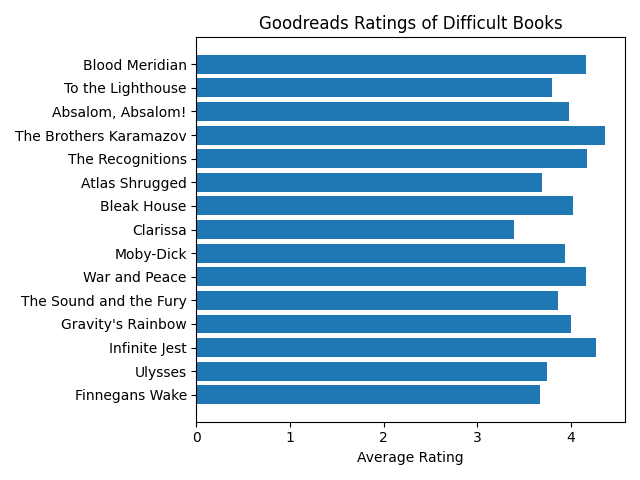
Average Goodreads Ratings of the Most Difficult Books.Despite their reputation for difficulty, many of these books maintain strong reader approval. Titles such as The Brothers Karamazov (4.36) and Infinite Jest (4.27) demonstrate that high difficulty does not necessarily reduce reader appreciation.
The Top Contenders: Why They Challenge Us
Finnegans Wake by James Joyce (1939) – 628 pages, Goodreads average rating: 3.67 Joyce's dream-like narrative uses a multilingual pun-filled language that defies conventional reading. Often called unreadable, it tops nearly every "hardest novels" list, including Goodreads' Most Difficult Novels (over 2,000 votes).
Ulysses by James Joyce (1922) – 730–783 pages, average rating: 3.75 Stream-of-consciousness style, shifting perspectives, and dense allusions to mythology make it a frequent second place. It leads Goodreads' Most Difficult Novels list with thousands of votes.
Infinite Jest by David Foster Wallace (1996) – 1,079 pages (including footnotes), average rating: 4.27 Over 1,000 pages with hundreds of endnotes (some with their own footnotes) create a fragmented narrative on addiction and entertainment. Regularly cited in Publishers Weekly and Early Bird Books as one of the toughest modern novels.
Gravity's Rainbow by Thomas Pynchon (1973) – 760–776 pages, average rating: 4.00 Nonlinear plot, scientific digressions, and paranoia-filled prose earn it consistent mentions alongside Joyce and Wallace.
The Sound and the Fury by William Faulkner (1929) – 326 pages, average rating: 3.86 Multiple unreliable narrators and non-chronological timelines challenge comprehension. Third on many Goodreads difficult lists.
War and Peace by Leo Tolstoy (1869) – 1,225 pages, average rating: 4.16 Epic length combined with philosophical essays and hundreds of characters make it daunting despite its narrative power.
Moby-Dick by Herman Melville (1851) – 544 pages, average rating: 3.94 Cetology chapters and symbolic density often lead to high abandonment rates in reader surveys.
Clarissa by Samuel Richardson (1748) – 1,499 pages, average rating: 3.39 Epistolary format and extreme length (longest English novel) place it high on historical difficulty lists.
Bleak House by Charles Dickens (1853) – 1,017–1,296 pages (depending on edition), average rating: 4.02 Dual narration, fog-shrouded symbolism, and sprawling cast create immersion challenges.
Atlas Shrugged by Ayn Rand (1957) – 1,088 pages, average rating: 3.69 Lengthy philosophical speeches polarize readers and contribute to its reputation.
The Recognitions by William Gaddis (1955) – 956 pages, average rating: 4.17 Dense satire and forgery themes make it a frequent "most difficult" pick in literary circles.
The Brothers Karamazov by Fyodor Dostoevsky (1880) – 796–824 pages, average rating: 4.36 Philosophical debates and psychological depth demand focused reading.
Absalom, Absalom! by William Faulkner (1936) – 303 pages, average rating: 3.98 Fragmented Southern Gothic narrative rivals his other works in complexity.
To the Lighthouse by Virginia Woolf (1927) – 209 pages, average rating: 3.80 Stream-of-consciousness and internal monologues challenge linear expectations.
Blood Meridian by Cormac McCarthy (1985) – 337 pages, average rating: 4.16 Brutal violence and sparse punctuation create an unrelenting read.
You might also like: The #1 Most Sold Book of All Time
Insights from Reader Data
Goodreads' "Most Difficult Novels" list (over 2,000 votes) places Joyce's works at the top, followed by Faulkner, Melville, and Wallace. Similar patterns appear in Publishers Weekly and Millions compilations.
Abandonment rates (DNF, or "did not finish") are harder to quantify precisely, but discussions on Goodreads and Reddit highlight these titles for high dropout rates due to density or length. For instance, Infinite Jest and Ulysses frequently appear in "abandoned books" threads.
These challenges often stem from innovation. Authors like Joyce experimented with language to capture consciousness. Faulkner shattered chronology to mirror memory. Wallace used footnotes to mimic modern distraction.
Yet readers who persevere report profound rewards: deeper empathy, expanded thinking, and a sense of accomplishment.
Approaching These Literary Mountains
Start slowly. Guides or annotations help with Ulysses or Finnegans Wake. Join reading groups for support with longer works like War and Peace.
Difficulty is subjective. What overwhelms one reader inspires another.
If these masterpieces feel intimidating, there is a compassionate way in.
BookFlow distills each of these challenging novels into thoughtful 20–30 minute summaries: key structures, themes, innovations, and why they matter, without losing their intellectual weight.
Download BookFlow and experience the greatest literary challenges in a way that fits your life.